Published
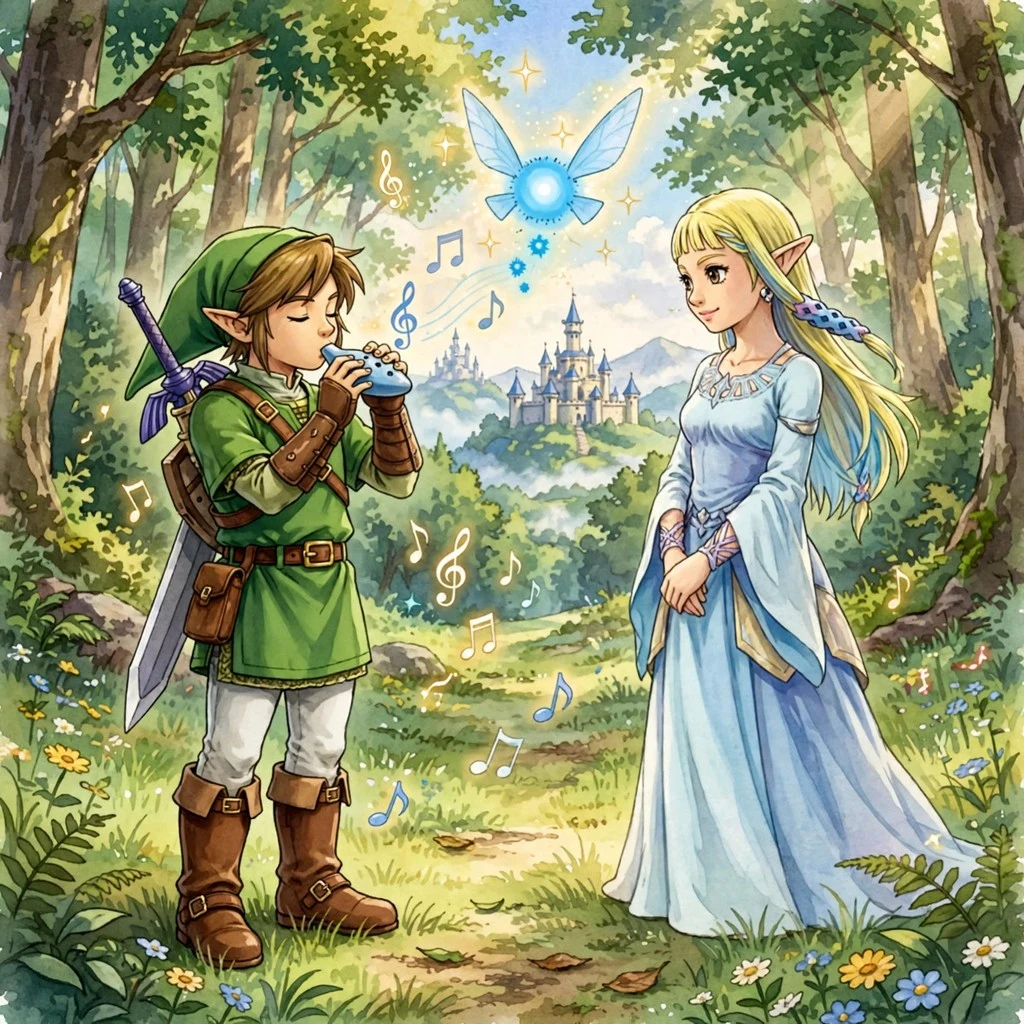
For 28 years, Ocarina of Time mostly talked in text boxes. Link grunted, Navi shouted “Hey! Listen!”, and everyone else’s lines sat on screen in silence. The Switch 2 remake flips that. Cutscenes are fully voiced, the dialogue has been expanded, and Koji Kondo’s soundtrack has been reworked as full symphonic orchestral music. Link, though, still doesn’t speak. Here’s what that actually means in practice, what Nintendo has confirmed, and what it hasn’t.
The short version
- Major cutscenes are fully voiced in the remake, with expanded character dialogue. Nintendo confirmed this at the Zelda 40th Anniversary Direct on September 8, 2026.
- Link remains silent. He still gets yelps, shouts, and grunts, not spoken sentences.
- Characters heard speaking in trailers and previews include Zelda, Saria, Darunia, Ruto, Ganondorf, Impa, and Navi.
- Nintendo has NOT announced the voice cast for the remake. Any cast list you see for the game right now is speculation, not a Nintendo announcement.
- The soundtrack is symphonic orchestral music, replacing the original’s sampled/MIDI-style sound, with refreshed sound effects alongside it.
- The music isn’t only background. Ocarina songs are playable, and the Switch 2 microphone lets you hum or play a learned melody and have Link perform it in game.
- Release date: November 5, 2026, exclusively on Nintendo Switch 2.
Watch: Nintendo’s official overview trailer
What the original sounded like
It helps to remember how little voice work the 1998 game actually had. There was no spoken dialogue to speak of. Characters communicated through text, Link made short effort sounds when he swung, rolled, or took a hit, and Navi’s job was mostly two words, delivered often enough to become a joke that outlived the console it came from.
That was normal for 1998, and it shaped how people remember these characters. If you played Ocarina of Time as a kid, you supplied Zelda’s voice, Ganondorf’s voice, and Saria’s voice yourself, in your head, for years. A remake that gives them real voices is always going to feel strange at first, because it’s replacing a performance you invented with one Nintendo chose.
Breath of the Wild and Tears of the Kingdom already moved Zelda in this direction, with fully voiced cutscenes and a silent Link. The remake follows that same pattern. It’s not Nintendo suddenly deciding Link should talk. It’s Nintendo bringing its oldest 3D Zelda up to the house style the series has used for its last two big entries.
Who talks, and who stays quiet
The clearest line Nintendo has drawn is around Link. He does not get dialogue lines. What he gets, as in Breath of the Wild and Tears of the Kingdom, is the physical stuff: shouts in combat, effort sounds, reactions. The people around him do the talking.
That list, from Nintendo’s own trailer material and hands-on previews, covers the characters you’d expect to carry the story: Zelda, Saria, Darunia, Ruto, Ganondorf, Impa, and Navi. Saria talking to Link about leaving the forest is one of the moments preview coverage singled out, and Ganondorf’s voice in the trailer is the one that got the most attention, because a silent villain in text suddenly has a tone, a pace, and a threat level you can hear.
One honest flag here, because it’s easy to get wrong: the live-action Zelda film cast is NOT the game cast. Names attached to the film, which arrives in 2027, do not transfer to the remake just because both are Zelda projects. Nintendo has not confirmed who voices anyone in the remake, and a familiar-sounding Ganondorf in a trailer is not a casting announcement. Treat any game cast list floating around before launch as a guess until Nintendo publishes one.
What “expanded dialogue” actually adds
“Fully voiced” on its own would just mean the old text, read aloud. Nintendo is also saying the dialogue has been expanded, and the previews back that up in small, specific ways rather than big plot rewrites.
Navi gets new lines, according to hands-on previews, and Kaepora Gaebora — the owl whose long speeches were a running joke in 1998 — no longer traps you in the same way, with previews describing a quieter, shorter owl. That second point matters more than it sounds. The owl wasn’t just long-winded; in the original, getting stuck re-reading his speeches was a real, remembered annoyance. Trimming that, while giving Navi more to say, is Nintendo editing the game’s talkativeness, not just recording it.
Kaepora Gaebora’s role is also bigger in the remake’s presentation, with the owl narrating and watching over Link’s adventure in trailer material, and bringing Link to the Hall of Fallen Heroes. That’s presentation and framing, not a new story — the remake keeps the 1998 story recognizable — but it does mean the character who used to just show up and talk a lot now feels like a presence across the whole game.
Don’t expect a rewritten plot. The expansion here is lines, context, and performance around the story you already know, not a different ending or a new villain.
The soundtrack: same tunes, a full orchestra
Koji Kondo’s 1998 soundtrack is one of the reasons Ocarina of Time stuck around. The Hyrule Field theme, Zelda’s Lullaby, the Song of Time, Saria’s Song — these aren’t background filler, they’re the game’s memory system. You hear a few notes and you’re back in a specific place at a specific age.
The remake keeps those melodies and rebuilds how they sound. Nintendo describes it as symphonic orchestral music, and preview coverage describes the old MIDI-style soundtrack swapped for a full orchestra. That is a bigger change than “better audio quality.” A sampled string line and a real orchestra section don’t just sound cleaner; they breathe differently, swell differently, and land differently in a boss fight or a quiet village.
Refreshed sound effects sit alongside the music, so the whole soundscape gets the same treatment, not just the headline themes. What Nintendo has not done, at least in anything released so far, is publish a track list for the remake, or confirm whether every single 1998 cue returns in orchestrated form. Assume the famous themes are there — they’re all over the trailers — and treat anything about a complete, note-for-note soundtrack as unconfirmed until the game is out and people can check it against the original.
One related point worth keeping separate: the remake’s ocarina itself. You can hum or play a learned melody into the Switch 2 microphone and Link will perform it in game, and Nintendo is also selling playable ocarina accessories. That’s not the soundtrack, exactly. It’s the game’s music becoming something you do, not just something you hear. It also means the songs you learned by button presses in 1998 now have a second way in, through your own voice or a real instrument.
Voice and music, side by side
| What you hear | 1998 original | Switch 2 remake |
|---|---|---|
| Cutscene dialogue | Text boxes, almost no speech | Fully voiced cutscenes |
| Link | Grunts and shouts, no sentences | Still silent, yelps and shouts only |
| Zelda, Saria, Ganondorf, and the rest | Text only | Voiced, with expanded dialogue |
| Navi | “Hey! Listen!” and short chirps | Voiced, with new lines reported in previews |
| Kaepora Gaebora | Long, repeatable speeches | Shorter in previews, bigger narrating presence |
| Soundtrack | Sampled / MIDI-style sound, Koji Kondo themes | Full symphonic orchestral music |
| Sound effects | 1998 samples | Refreshed sounds |
| Ocarina songs | Button sequences only | Buttons, plus hum/play into the microphone |
What to listen for on November 5
If you play at launch, the things worth paying attention to aren’t the ones in the marketing bullet points. They’re the small ones: whether Ganondorf sounds menacing or just loud, whether Zelda’s expanded lines actually add anything to scenes you could recite from memory, and whether the orchestra makes Hyrule Field feel bigger or just louder.
The risk with all of this is the same risk every remake of a beloved game carries. The original’s sound lived in your head for 28 years, and no orchestra and no voice cast can match a memory perfectly. The previews so far split on this — some found the English voices a touch grating, others found the whole package snappy and polished — and that split is probably honest. You don’t get to hear a character for the first time twice, and for Ocarina of Time, a lot of players already heard them the first time, in their own heads, in 1998.
The other thing to watch is the cast announcement, or the lack of one. Nintendo going all the way to launch without naming its voice actors would be unusual, and it leaves the conversation full of guesses. When Nintendo does name them, that list — not a trailer guess, not a film cast list — is the one to trust.
FAQ
Are the cutscenes in the Ocarina of Time remake fully voiced?
Yes. Nintendo confirmed fully voiced cutscenes with expanded dialogue at the Zelda 40th Anniversary Direct. Voice work is in cutscenes, in the style of Breath of the Wild and Tears of the Kingdom.
Does Link talk in the remake?
No. Link remains silent, with yelps, shouts, and grunts instead of spoken lines. The characters around him speak; he doesn’t.
Who voices the characters in the remake?
Nintendo has not announced the voice cast. Zelda, Saria, Darunia, Ruto, Ganondorf, Impa, and Navi are heard speaking in trailers and previews, but their actors have not been officially confirmed. Don’t confuse this with the live-action Zelda film cast.
Is Navi’s original voice actress back?
Not confirmed. Fans comparing Japanese trailers have said Navi sounds like Kaori Mizuhashi, who voiced Navi in 1998, but Nintendo has not confirmed that, and fan comparison is not a casting announcement. The English Navi voice is likewise unconfirmed.
Is the soundtrack orchestrated?
Yes. Nintendo describes full symphonic orchestral music, replacing the original’s sampled/MIDI-style sound, with refreshed sound effects. Koji Kondo’s themes return in orchestrated form.
Can you play the ocarina with your voice?
Yes, for songs Link has learned. Hum or play a melody into the Switch 2 microphone and Link performs it in game. Button input still works too.
When does the Ocarina of Time remake come out?
November 5, 2026, exclusively on Nintendo Switch 2.
The bottom line
The remake doesn’t just look newer, it sounds like a different kind of game: a cast that actually speaks, a score played by an orchestra, and an ocarina you can play with your voice. Link staying silent is the right call — he’s the one character whose voice was always yours. The open question is whether the new voices live up to 28 years of imagined ones, and Nintendo still owes us the cast list that would let us judge that properly.
Sources
- Nintendo’s Legend of Zelda 40th Anniversary Direct (September 8, 2026) and official remake materials, via Nintendo’s official overview trailer
- NotebookCheck, “Zelda remake arrives Nov 5 with voiced cutscenes” — voiced cutscenes, Link silent, cast not announced
- GameSpot, “The Ocarina Of Time Remake Is Adding Something We Never Saw Coming: Voice Acting” — fully voiced cutscenes, characters heard speaking, cast unconfirmed
- Kotaku, “Fans Think Navi’s Original Actor Is Back For Ocarina Remake” — Japanese Navi comparison, unconfirmed, Nintendo asked for confirmation
- Voice Over Herald, “Ocarina of Time’s Voice Cast Is Still a Mystery” — voice limited to cutscenes, cast unconfirmed
- RPGamer, “The Legend of Zelda: Ocarina of Time Remake Overview Trailer Released” — fully voiced cutscenes, symphonic orchestral music, overview trailer details
- Digitally Downloaded, “Nintendo reveals an overview trailer for The Legend of Zelda: Ocarina of Time remake” — fully voiced cutscenes with expanded dialogue, full symphonic orchestral music
- Martin Cid Magazine, “Zelda: Ocarina of Time Remake Previews Find a Quieter Owl and New Navi Lines” — quieter Kaepora Gaebora, new Navi lines, preview-reported
Related on New Game Wire
- Zelda Ocarina of Time Remake: Release Date, Price, and What’s Actually Different vs the Original (pillar)
- Zelda Ocarina of Time Remake: Hall of Fallen Heroes Explained
- Zelda Ocarina of Time Remake: New Controls Explained — Jump Button, Free Camera, Sprint, and Motion Aiming
- Nintendo Switch 2 vs. Switch OLED in 2026: Which Should You Buy?
- Nintendo Switch 2 Game-Key Cards Explained: Physical, Digital or Both?
Leave a Reply