Published
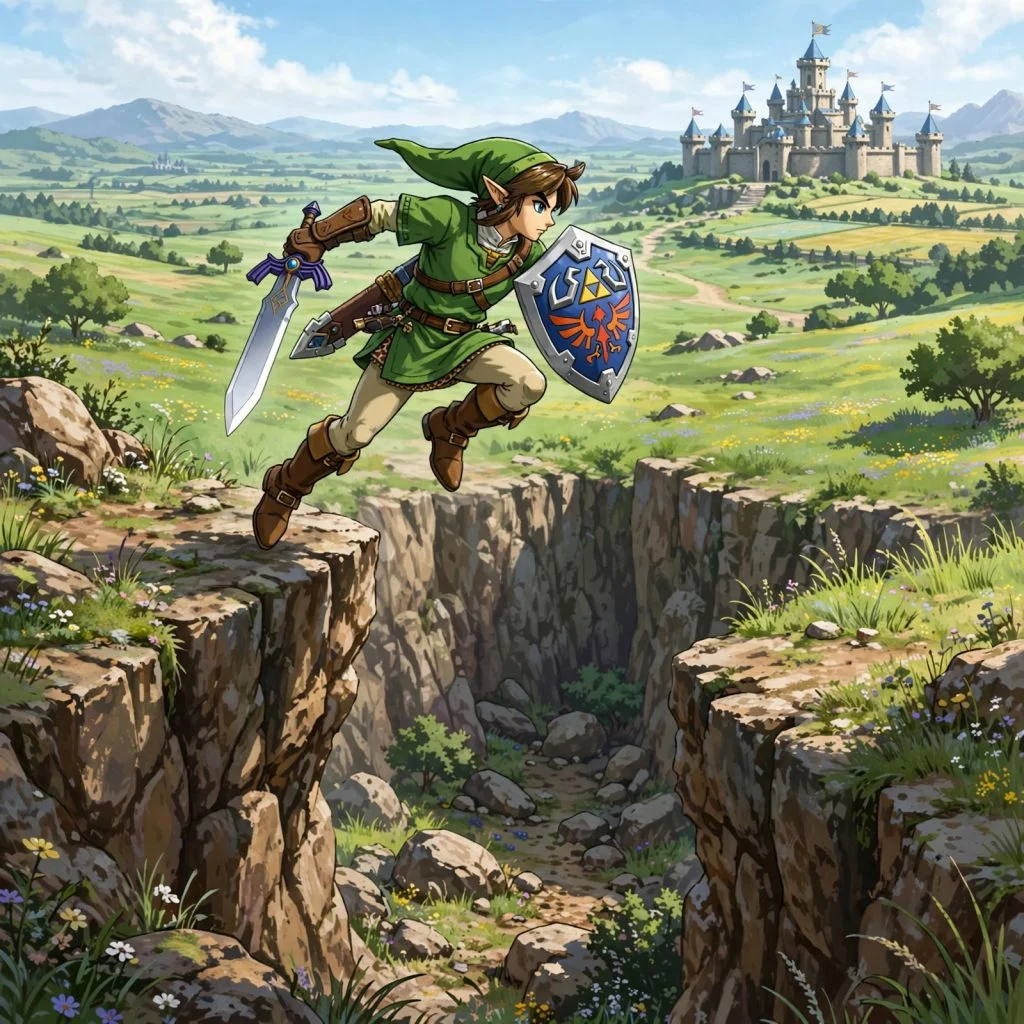
The Switch 2 remake of Ocarina of Time changes how the game feels in your hands more than any other part of it. The story, the dungeons, and the world are the same adventure from 1998, but Nintendo has rebuilt the controls around a modern controller: Link finally jumps when you tell him to, the camera follows your right stick instead of locking to fixed angles, and he can sprint. Here’s every confirmed change, what it replaces from the original, and what Nintendo still hasn’t spelled out.
The short version:
- A dedicated jump button replaces the original’s automatic jumping. You decide when Link leaves the ground.
- The camera is fully free on the right stick, replacing the N64 original’s fixed and context-locked viewpoints.
- A sprint button lets Link run, where the original had no sprint at all and fast players chained forward rolls to move quicker.
- Slingshot, bow, and other ranged gear can be aimed with motion controls.
- Items can be swapped on the fly from a scrolling item bar instead of pausing to the menu every time.
- The remake runs at 60 frames per second in the footage Digital Foundry measured (1080p in the September footage); Nintendo has not confirmed a docked resolution.
- Release date: November 5, 2026, exclusively on Nintendo Switch 2.
Watch: Nintendo’s official overview trailer
Nintendo’s official overview trailer.
Jump: from automatic to on command
This is the single biggest change. In the 1998 original, Link jumped on his own whenever you ran him off a ledge. You never pressed a jump button because there wasn’t one; the game decided when a gap was crossable and when a ledge was climbable.
The remake gives you a dedicated jump button. One press sends Link hopping across gaps and over obstacles, and you choose the moment. That sounds small until you think about what it touches: platforming sections where timing used to be automatic, combat spacing where a hop can now be a deliberate move, and exploration where a jump might reach places the original never let you try. Nintendo has rebuilt environments to suit it — Hyrule Castle Town, which was a pre-rendered backdrop with a fixed camera in 1998, is now a fully explorable 3D area, partly because a free camera and a jump button need real geometry to work with.
Camera: free on the right stick
The N64 original’s camera was one of its most dated parts. Views were fixed or context-locked, and you nudged them with shoulder buttons more than you steered them. The remake puts the camera on the right stick and lets you spin it freely around Link in fully remodeled locations.
That matters most in dungeons. The original’s vertical spaces — the Forest Temple’s twisted corridors, the Water Temple’s stacked levels — were designed around a camera you couldn’t fully control. A free camera lets you actually look at those spaces, spot ledges and switches from angles the original hid, and read puzzle rooms the way a modern game lets you. Previews from hands-on sessions in Kokiri Forest, Castle Town, and the Forest Temple describe the view as free to spin around Link, and the rebuilt visuals — sunlight on puddles, grass on Hyrule Field — are built to be looked at from any angle.
One thing that hasn’t changed: the game still uses loading screens between certain areas. Producer Eiji Aonuma has said that’s deliberate, to preserve the feel of the original, so don’t expect one seamless Hyrule. The field itself also keeps the original’s bounded design rather than opening out into something Breath of the Wild-sized.
Sprint: Link can finally run
The original had no sprint. Players who wanted to cross Hyrule Field faster rolled, over and over, because a forward roll was the quickest movement the game allowed. The remake adds a dedicated dash ability — hold a button and Link sprints. Hands-on previews describe running as a proper ability now, not a trick, and the difference shows up most on Hyrule Field, where the trip between locations used to be a long roll-chain broken up by encounters.
Swimming is faster too, according to the remake’s confirmed gameplay changes, which should take some of the sting out of the Water Temple’s backtracking.
Motion aiming and the item bar
Aiming the slingshot and bow with motion controls is the remake’s nod to how the Switch 2 controllers actually work. Previews single out the Castle Town shooting gallery as the place this shows up best: in 1998, players fumbled a then-new analog stick and fed the gallery owner plenty of rupees, while preview players report targets dropping on the first try with smoother frame rates and fine motion aiming.
The item system gets a quieter but arguably more useful fix. Instead of pausing to the menu every time you need a different tool, a scrolling item bar lets you swap items on the fly, in the style of Breath of the Wild. Combined with a larger wallet for rupees, reported in previews, the remake trims a lot of the original’s menu busywork. Note the distinction here: the jump, camera, sprint, and motion aiming are Nintendo-confirmed changes, while the larger wallet and some item-bar details come from preview reports rather than Nintendo’s own materials.
Old vs new controls, at a glance
| What you do | 1998 original | Switch 2 remake |
|---|---|---|
| Jump | Automatic at ledges, no button | Dedicated jump button, you choose when |
| Camera | Fixed / context-locked views | Free camera on the right stick |
| Run | No sprint; forward rolls were fastest | Dedicated sprint button |
| Aim slingshot / bow | Analog stick | Motion controls available |
| Swap items | Pause to menu | Scrolling item bar, swap on the fly |
| Swimming | Slow, deliberate | Faster |
| Frame rate | Around 20 fps | 60 fps in measured footage |
| Castle Town | Pre-rendered, fixed camera | Fully explorable 3D area |
| Time in towns | Paused in towns and buildings | Passes continuously everywhere |
What this means for returning players
If you have the original memorized, the remake will feel wrong for about an hour and then better. Muscle memory built around auto-jump and fixed cameras will misfire — you’ll run off ledges expecting the game to jump for you, and you’ll reach for camera buttons that no longer do what they did. That’s the adjustment cost. The payoff is a version of Ocarina of Time where movement is actually under your control, which is the one thing the original never quite offered despite inventing the 3D action-adventure template everyone else copied.
New players get the cleaner deal. They’ll meet Ocarina of Time as a game that controls like a modern one, with the original’s dungeon design and story underneath. The remake’s other aids — the Threads of Time log that tracks your objective, and the Zelda Notes phone service — exist for the same reason: Nintendo knows a 1998 game needs modern scaffolding for a 2026 audience.
FAQ
Does the remake have a jump button? Yes. Link jumps on command with a dedicated button, replacing the original’s automatic jumping at ledges.
Can you move the camera freely? Yes. The right stick controls a free camera in the remake’s remodeled locations, replacing the original’s fixed viewpoints.
Can Link sprint? Yes. A dedicated sprint button lets Link run; the original had no sprint, which is why players chained forward rolls to move faster.
Does motion aiming work for the bow and slingshot? Yes. Motion controls handle aiming for the slingshot, bow, and other ranged gear, according to Nintendo’s controls material and hands-on previews.
Is the remake 60 fps? Digital Foundry measured the September footage at 1080p and 60 fps. Nintendo has not confirmed a docked resolution, so treat docked specs as unconfirmed.
When does the Ocarina of Time remake come out? November 5, 2026, exclusively on Nintendo Switch 2.
Has Nintendo detailed Z-targeting changes? Not in the controls material released so far. The confirmed changes are jump, camera, sprint, motion aiming, item swapping, and faster swimming; anything about targeting beyond that is unconfirmed, so don’t take preview silence as a removal.
The bottom line
The controls are the remake’s real argument for existing. A new coat of visuals alone wouldn’t have justified rebuilding Ocarina of Time; a jump button, a free camera, and a sprint button do, because they change how every room, field, and fight actually plays. November 5 will tell whether the new controls hold up across the full game, but on paper this is the right set of fixes for a 28-year-old classic.
Sources
- Nintendo’s Legend of Zelda 40th Anniversary Direct (September 8, 2026) and official remake materials, via Nintendo’s official overview trailer
- NotebookCheck, “Zelda remake arrives Nov 5 with voiced cutscenes” — 60 fps measurement, jump button, free camera, motion aiming
- God Is A Geek, “Ocarina of Time Remake Preview: Sprint, Jump, Motion Aim” — sprint, item bar, shooting gallery, hands-on impressions
- 80 Level, “Ocarina of Time Remake Adds Jumping, Sprinting & Voice Acting” — Direct presentation details
- The Legend of Zelda: Ocarina of Time (2026 video game), Wikipedia — consolidated gameplay changes list
- Nintendo World Report, via SBCC World, “Ocarina of Time Remake Adds Jump Button, Free Camera” — jump and camera confirmation
Leave a Reply