Welcome to WordPress. This is your first post. Edit or delete it, then start writing!
Author: tahoecale
-
Phantom Blade Zero Looks Incredible. The Combat Has to Back It Up.
Preview · Updated October 8, 2026
Phantom Blade Zero has already won the argument about whether sword fighting can look cool. The harder argument is whether it will feel that good when you are the one pressing the buttons.
That is where this preview starts. S-GAME’s action RPG pairs wuxia choreography with mechanical prosthetics and dark industrial scenery. It has a lead character who is hunted, framed, and running out of time. It also promises enough weapons to keep an action-game obsessive busy.
There is plenty to be excited about. There are also better questions to ask than whether a trailer deserves a game-of-the-year trophy.
A dramatic sword fight is only useful if you can control it
The official PlayStation page lists more than 30 primary weapons and over 20 Phantom Edges. It describes a combo system designed to be approachable but demanding to master, with motion-captured martial-arts choreography shaping the attacks.
The number of weapons is the headline. The difference between them is what will matter.
Fifty ways to produce a flashy animation would be less interesting than a smaller arsenal that changes your approach to a fight. A good combat system gives you reasons to choose reach, speed, recovery, or a particular response to an enemy. It should let you get better at making those decisions, rather than only get better at remembering a sequence.
Watch an extended gameplay sequence with that in mind. Can you follow the enemy’s preparation for an attack? Does the player have room to recover from a bad choice? Do defensive actions flow into an attack you can understand? A trailer can hide those details. A longer fight has to show them.
The Souls comparisons are less useful than they sound
In a Reddit discussion comparing Phantom Blade Zero and Onimusha, commenters reach for Sekiro, Nioh, and other action games to describe what they expect. Others focus on the animation or want a demo before deciding.
That is normal: players use games they know to explain games they have not played. It becomes a problem when the comparison turns into a promise about how the new game works.
A dark setting and a sword do not tell you the pace of combat, how failure is handled, or how much room there is for experimentation. Steam’s community tags are also user-defined. Treat a “Souls-like” tag as a sign of what people are comparing, rather than a complete design document.
The useful question is what you actually enjoy. Precise defensive timing? Aggressive combos? Learning a weapon until it feels like an extension of your hands? Look for evidence of that specific experience.
Soul’s sixty-six days are a story hook, not a timer we should invent
Soul is accused of killing his master and left with a damaged heart. With sixty-six days remaining, he travels through the Wulin trying to expose the conspiracy around him.
It is an effective setup because it gives the investigation personal stakes. Clearing his name is already urgent; surviving long enough to do it makes the problem worse.
But a story deadline does not automatically mean there is a real-time countdown controlling your save file. The official premise establishes Soul’s situation. It should not be stretched into claims about timed quests or lost exploration time without confirmation.
We would rather see the urgency expressed through meaningful choices than have every optional corner feel like a mistake. How the finished game balances its story with curiosity will be worth watching.
The art direction has more going on than dark fantasy
S-GAME calls its mixture of martial arts and punk fantasy “kungfupunk.” The Steam page ties that identity to traditional Chinese imagery, machinery, ruined industrial spaces, and rock music.
That combination gives the game room to stand out. The test is whether those elements shape the places you explore and the people you meet, rather than simply decorate combat arenas.
A memorable world gives you things to talk about after a fight besides the boss’s health bar. A strange location, an unsettling character, or a discovery that changes your reading of the story can be just as valuable as another spectacular finish.
Release date, PC support, and what the editions include
PlayStation’s October guide lists an October 29, 2026 PS5 release. There is also a PC version on Steam; the listing retrieved for this update displays October 28. Check the store for your region and platform rather than assuming a universal local unlock time.
On PlayStation’s US page, Standard is $59.99 and Digital Deluxe is $69.99. Deluxe includes two appearances, a digital artbook, and a soundtrack. The listed preorder accessory and appearance are early unlocks that can also be earned through play. Those bonuses are optional extras, not reasons to decide whether the underlying combat suits you.
PC players should note that the advertised minimum and recommended performance targets use upscaling, and installation requires an SSD. Read the full specification notes, not just the GPU name.
Our take: the choreography and setting make Phantom Blade Zero worth following. The real reason to buy will be responsive combat with enough depth to outlast the spectacle. That is something footage can suggest, but sustained play has to prove.
What would convince you: a playable demo, detailed combat impressions, or seeing how it runs on your hardware?
Reporting and analysis based on the linked PlayStation and Steam pages, with attributed community discussion. This is a pre-release preview, not a hands-on review. Details and US PlayStation prices checked October 8, 2026.
-
Star Wars: Galactic Racer Has the Right Kind of Bad Attitude
Launch analysis · Updated October 8, 2026
The most interesting thing about Star Wars: Galactic Racer is that you can be a complete bastard on the track.
The official pitch actively includes shunting rivals and taking them down. This is an underground racing circuit, not a polite driving test with a Star Wars paint job. If your first instinct when someone pulls alongside you is to wonder how close the next wall is, Fuse Games is speaking your language.
But the collision-heavy racing is only half the story. Galactic Racer is also built around runs, which makes the campaign a more interesting proposition than a straightforward list of races. It gives your vehicle choices and willingness to take risks something to hang on.
The Burnout comparisons have a reason behind them
Fuse’s leadership includes developers with experience on Burnout and Need for Speed, as discussed in StarWars.com’s developer interview. That background explains why racing fans were watching before they knew much about Shade or the Galactic League.
In the r/Games launch discussion, several early players make the Burnout comparison themselves. They talk about boost, takedowns, and the satisfaction of aggressive racing. One also complains about awkward positioning after a crash.
That last point matters just as much as the praise. An arcade racer asks you to enjoy pushing too hard. The recovery after a mistake needs to get you back into the contest, rather than make you feel the game has handed you another crash. Those are individual impressions, but they identify something useful to watch for.
Different speeders should mean different decisions
The vehicle lineup includes landspeeders, speeder bikes, skim speeders, and podracers. The Steam description says the classes have different physics and playstyles, with customization letting you shape your ride.
That is a more promising foundation than four different silhouettes doing exactly the same job. For a racer to hold up, changing vehicles should alter how you approach a corner, respond to traffic, or pick a route. Otherwise, a garage becomes a costume selection screen.
Skim speeders are a particularly interesting part of the pitch. Fuse describes banking and knife-edge movement as part of their handling. That suggests a vehicle you learn to flow through a course rather than simply point at the finish line.
The question for longer play is whether the classes remain meaningfully different once players settle on upgrades. A favorite vehicle is good. A vehicle everyone feels forced to use is a balancing problem.
The campaign is asking you to think beyond one race
You play as Shade, chasing revenge and status in an unsanctioned Outer Rim league. Vehicle selection, build upgrades, and event choices are part of the developers’ explanation of the run structure.
That can make a racing campaign more compelling because the next event is also a decision about what your current setup can handle. Sometimes an aggressive build will fit the job. Sometimes the better move is to stop trying to drive everything like a battering ram.
The risk is repetition. A run structure needs enough variation for another attempt to feel like a new opportunity. Replaying a route can be satisfying when you are improving. Replaying it just to get back to the interesting bit feels like homework.
That is the difference we care about. “Runs-based” is a description of the structure, not a free pass on replay value.
Check the multiplayer details before planning game night
The Steam listing confirms online PvP and cross-platform multiplayer. It does not follow that every kind of session you want is supported.
The same Reddit launch thread includes complaints about private races, party limits, and the lack of a couch-play option. Treat those as prompts to check the current features, not as a substitute for official documentation. Multiplayer options and patches can change.
If you want to race with a large friend group, look specifically for lobby and party support before everyone buys a copy. “Has multiplayer” answers a much smaller question than “can the eight of us play exactly how we want?”
Price, platforms, and the PC check
Galactic Racer launched October 6 on PS5, Xbox Series X|S, and PC. Steam’s US listing shows $59.99 for the standard game and $79.99 for Deluxe at the time of this update. Its requirements include 50 GB of space and an SSD; compare the full specifications with your machine before checkout.
Our take: the hook is strong because it combines aggressive arcade racing with vehicle and campaign decisions. Star Wars supplies the setting, but the racing has to do the work. If you love chasing cleaner runs and making risky passes, investigate this one. If your main plan is couch multiplayer or a big private lobby, settle that question first.
Would you play it for the solo campaign, or is racing your friends the whole point?
Sources: linked official developer interview and Steam listing, official launch announcement, and attributed Reddit player impressions. New Game Wire has not conducted a hands-on review. Prices and details checked October 8, 2026.
-
Gears of War: E-Day Has to Earn the Nostalgia—and Horde Siege Is the Big Swing
Launch analysis · Updated October 8, 2026
Bringing back Marcus and Dom is the easy part. Making Gears feel dangerous again is the job.
That is why E-Day’s setup works. Fourteen years before the first Gears of War, the Locust invasion is just beginning. The people above ground have not spent years learning how to live through it. For a series built around soldiers who can look almost too comfortable in a firefight, going back to the moment everything falls apart gives the story somewhere useful to go.
The other reason to pay attention is Horde Siege. A bigger player count alone would be a boring selling point. Squads crossing paths, recovering each other’s tags, and trying to escape a mission that has gone sideways? That is a much better conversation.
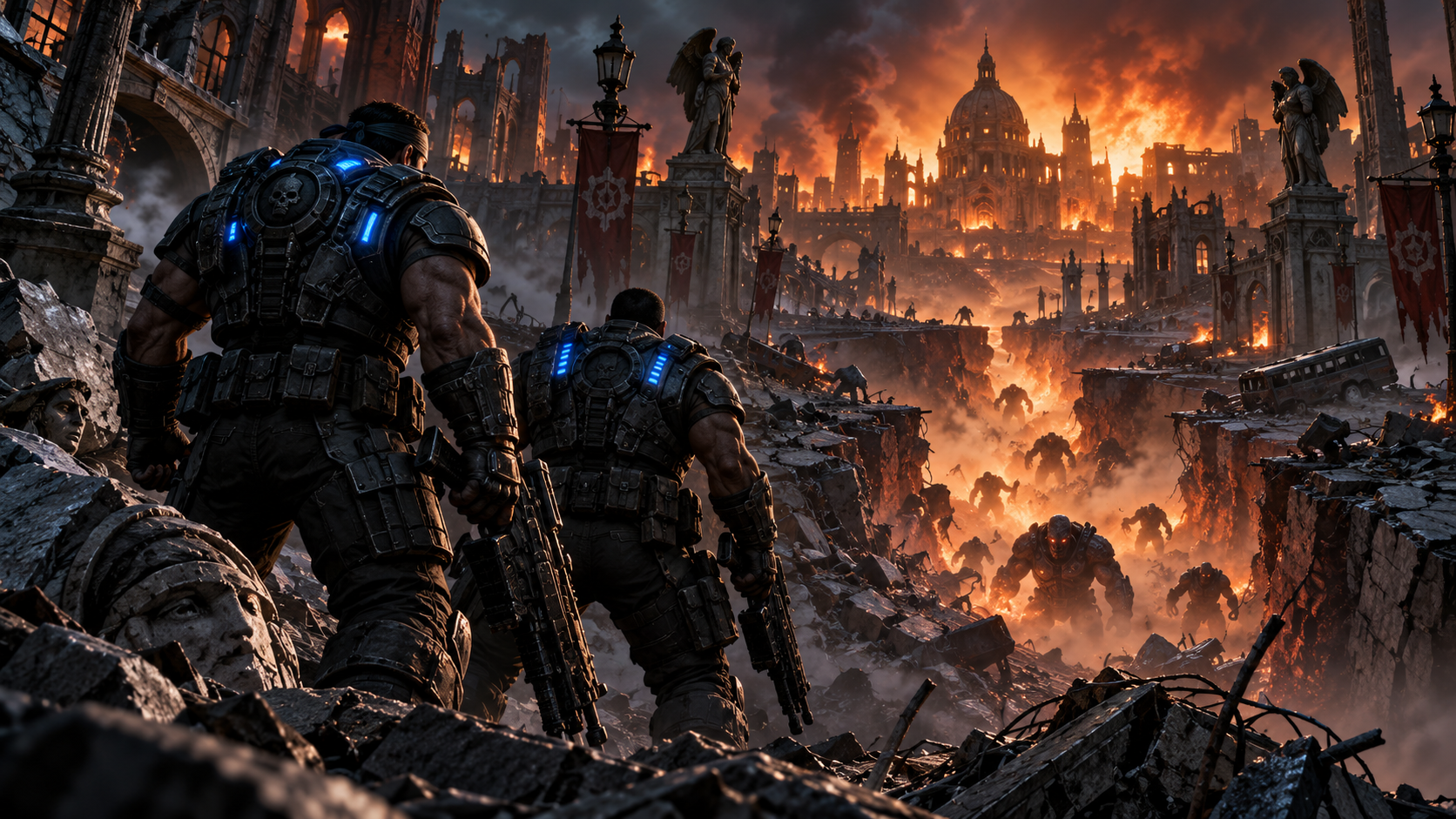
Original AI-generated editorial illustration inspired by Gears of War: E-Day. Not official art or a gameplay screenshot. Marcus and Dom need more than a nostalgia lap
A prequel has an awkward problem: we already know the world is going to lose. There is no suspense in asking whether Emergence Day will turn out fine. It will not.
The interesting question is what that first disaster does to the people caught inside it. Marcus and Dom’s friendship gives E-Day an emotional center, but familiar names should be the starting point. The moments between the gunfights need to make us care about who these men are before they become the characters we remember.
That is the standard we would judge this campaign against. More wreckage does not automatically mean more atmosphere. A quiet street, a frightened civilian, or a friend trying to keep the other one moving can do more than another building collapsing in the distance.
Horde Siege changes the problem your squad has to solve
The Coalition’s multiplayer breakdown describes a 12-player mode built around three squads operating across Kalona. Each squad has its own assignment, with routes and objectives bringing teams into contact before extraction.
That changes what teamwork means. Your group is making progress, but there are other people in the same battle whose decisions can affect the situation around you. A rescue can become more valuable than another kill.
One detail worth knowing: dead players leave COG tags. Teammates can return those tags to a Supply Cache for a revive; another squad can pick them up to revive the player immediately. Extraction also has a deadline. Finish the objectives, clear the landing zone, and actually make the ride.
Those rules create opportunities for the stories co-op players remember: someone doubling back when leaving would be safer, or a clean mission turning into a desperate recovery. The appeal is having decisions to make under pressure, rather than simply putting more targets on screen.
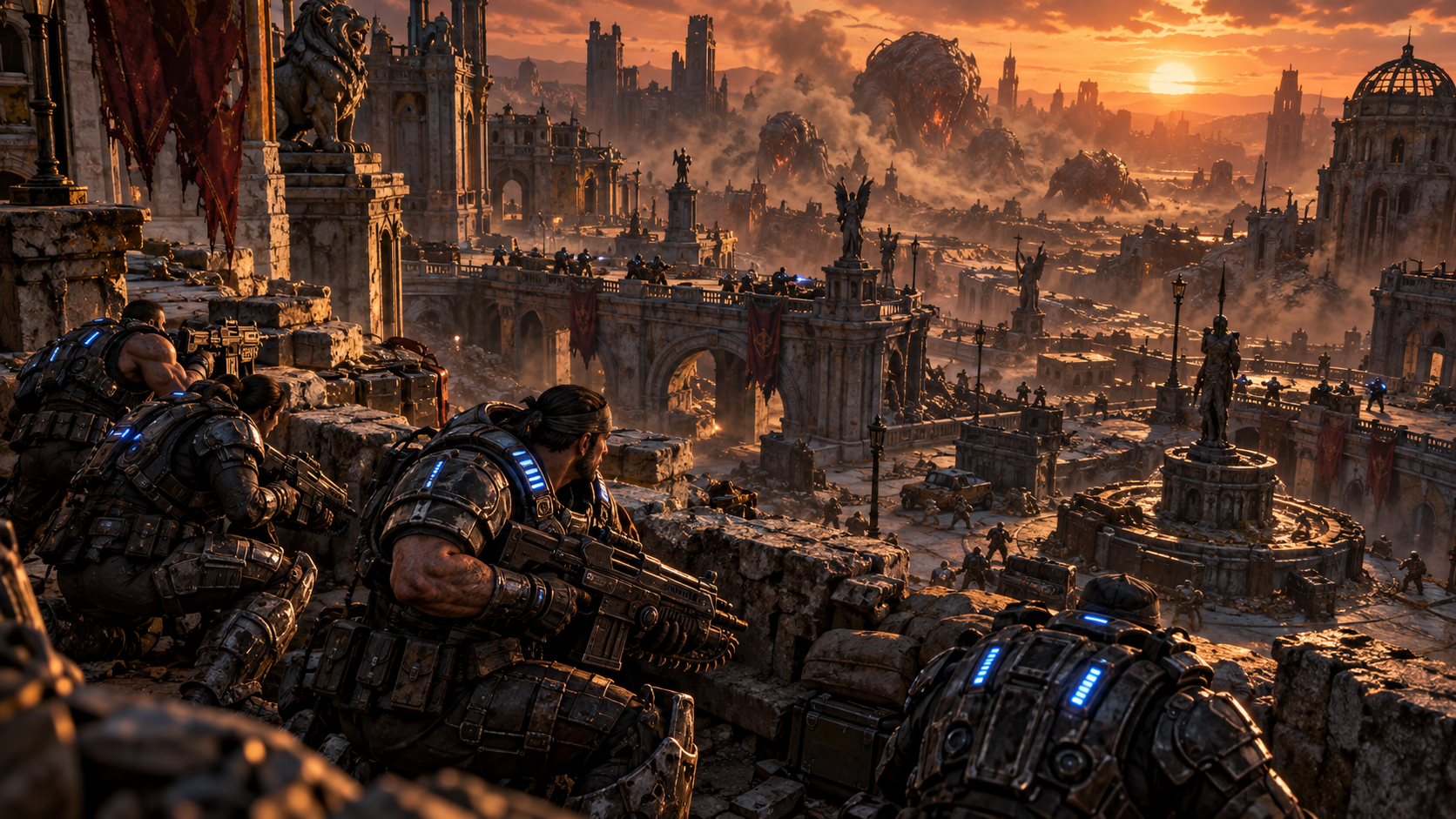
Original AI-generated editorial illustration inspired by Gears of War: E-Day. Not official art or a gameplay screenshot. Changing Horde will not make every Horde fan happy
In an early r/GearsOfWar discussion, one player praises Siege’s class progression while also wanting a classic Horde option alongside it. That is a useful distinction: enjoying the new mode does not erase the reason someone liked the old one.
If your ideal session is a familiar defensive setup with a regular crew, missions and extraction may be a different kind of night than you wanted. If you were tired of repeating that setup, the change may be exactly the attraction. Neither preference needs a lecture about being a “real fan.”
Versus keeps loadouts on an even starting line
Versus uses 4v4 teams, with equal starting equipment and no weapon mods. Power weapons on the map still give teams something to fight over. For competitive players, that separation matters: co-op progression can offer build experimentation without carrying those upgrades into PvP.
Learning the maps and coordinating with three teammates should be the first priority. Unlocking something impressive in Siege is not a substitute for knowing when to push a fight.
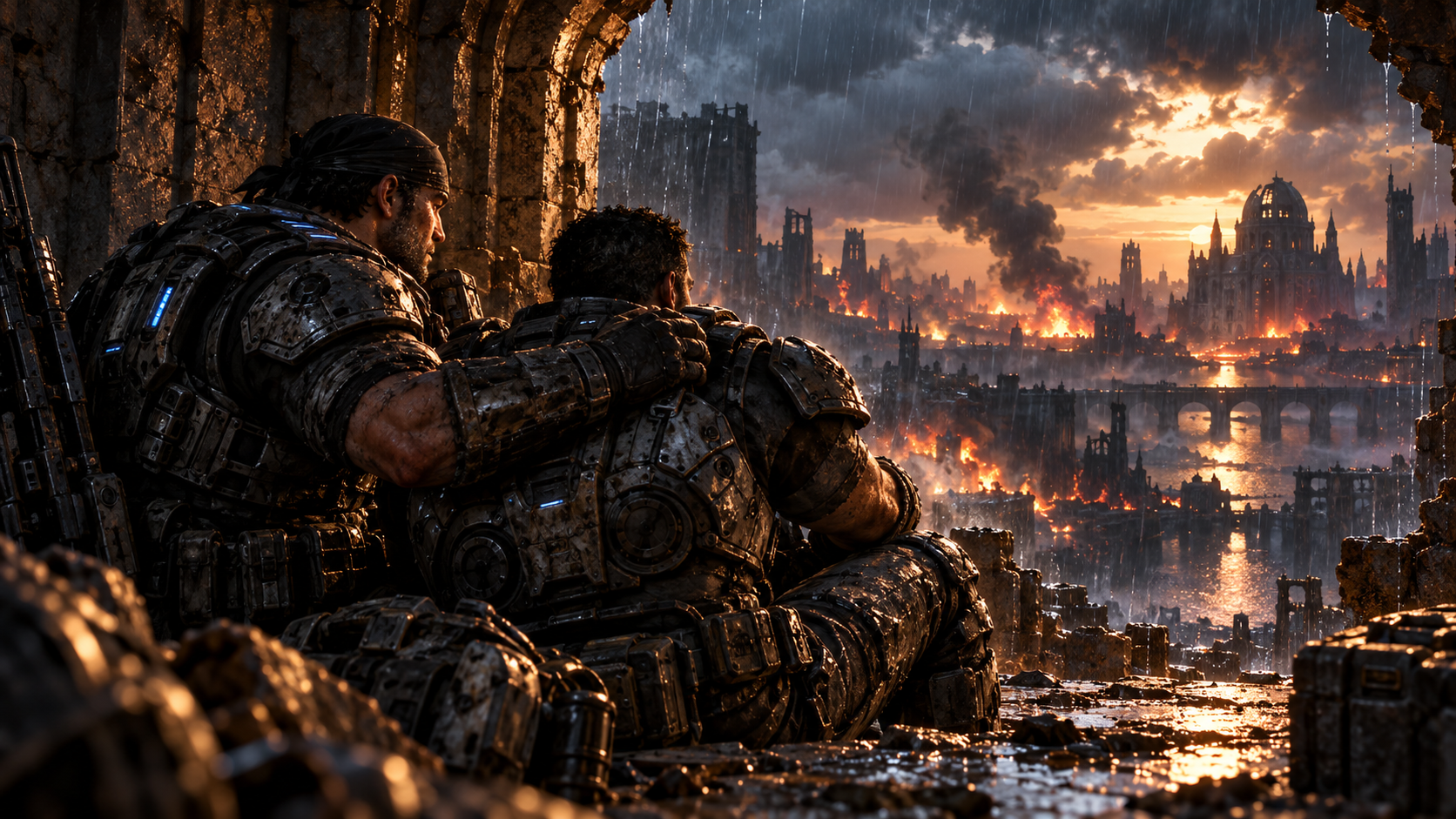
Original AI-generated editorial illustration inspired by Gears of War: E-Day. Not official art or a gameplay screenshot. What to check before you buy
E-Day’s full release was October 6 on Xbox Series X|S and PC, including Steam. The official edition guide lists Game Pass Ultimate and PC Game Pass access, plus Xbox Play Anywhere for eligible Xbox-store purchases.
Already subscribed? Check the game’s availability in your plan before paying for a separate copy. Buying on PC? Check the store and edition you actually intend to use; an Xbox-store benefit is not something to assume applies to a Steam purchase.
Our take: E-Day has a strong reason to revisit the beginning, and Siege has mechanics worth discussing beyond its player count. The campaign has to earn the nostalgia. The multiplayer has to make its new teamwork worth returning to. Those are better tests than how excited a launch trailer makes us.
Would you rather play Siege’s moving missions or hold a classic Horde position with the same squad?
New Game Wire analysis based on official release and multiplayer information, with linked community commentary. This is not a hands-on review. Details checked October 8, 2026.